
Combined water-tube industrial boilers
The efficient integration of heating systems represents an optimal technical solution for paper mills. In particular, the use of a combined water-tube boiler makes it possible to maximise energy recovery, integrate multiple heat sources and ensure flexible and efficient steam production, thereby reducing fuel consumption, operating costs and emissions into the atmosphere.
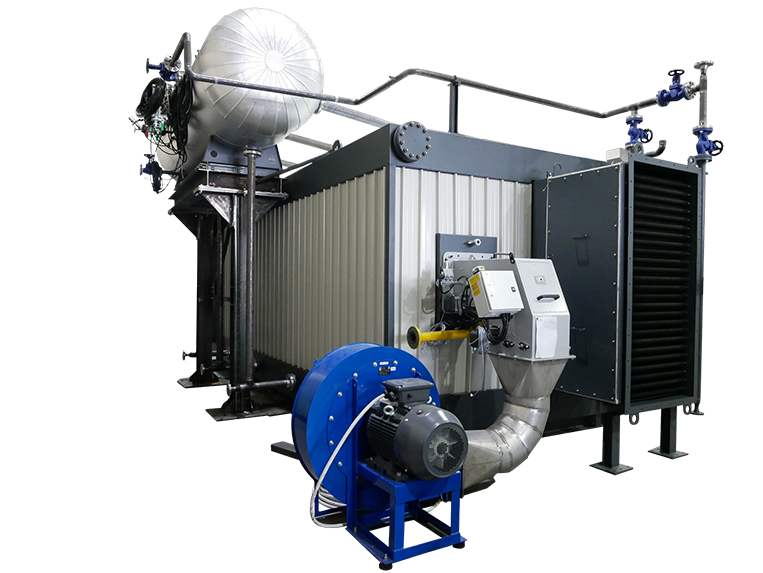
Figure 1: The WT-CB combined water-tube boiler with heat recovery from Garioni Naval, part of the Svecom-P.E. group.
In this scenario, the use of a combined water-tube boiler can represent a practical solution for maximising energy efficiency, reducing operating costs and limiting emissions into the atmosphere.
Federico Baroni, Commercial Director of Garioni Naval www.garioninaval.com, spoke about this at MIAC 2025.
The underlying idea is to move beyond a fragmented view of systems, which is still very widespread in paper mills, and move towards an integrated system capable of making the most of all available energy sources within the mill. As Baroni points out, ‘today it is no longer enough to simply add a system to solve a specific problem; we need to consider how that investment fits into the overall picture of the paper mill’s energy efficiency’.
The energy challenges facing the paper industry
The enormous demand for steam – which is essential for the various stages of the production process, from drying through to the final treatments – is the key feature of paper mills. Alongside steam, Baroni points out, ‘the demand for electricity is just as high’, leaving paper mills highly exposed to the dynamics of the energy markets. Added to these factors is the issue of efficiency. “Every paper mill is required to optimise its consumption not only to reduce operating costs, but also to maintain an adequate level of competitiveness”, especially in an increasingly globalised market.
Furthermore, in recent years, environmental sustainability has taken on a central role. “Companies must comply with increasingly stringent national and international regulations, but above all they must meet customer expectations”, who are demanding products with a lower environmental impact and a more transparent energy supply chain. Based on these requirements, explains the director, many industrial firms have progressively adopted various technologies.
Initially, one or more flame-fired steam generators were installed to meet the heating requirements. Subsequently, to reduce the cost of purchasing electricity, on-site power generation systems such as gas turbines, internal combustion engines or microturbines were introduced, often combined with waste heat recovery boilers. The problem, as Baroni points out, is that ‘in most cases these investments were not planned in a coordinated manner’.
The immediate objective of resolving a single critical issue has often taken precedence over the bigger picture, resulting in redundant systems, high operating and maintenance costs, and an overall efficiency level below potential.
This leads to ‘the need to identify a system capable of integrating all the energy sources present in the paper mill and responding flexibly to production requirements’.
Interested in a professional system?
Our experts are here to help!
The combined water-tube boiler
According to Garioni Naval, the solution to these challenges lies in the WTCB combined water-tube boiler (Figure 1). “This is a solution designed to maximise steam production and intelligently integrate the various energy sources available within the paper mill,” continues Baroni.
The aim is to achieve efficient steam production by prioritising energy recovery and resorting to combustion only when necessary, using low-emission technologies. “The WT-CB is a modular recovery boiler, equipped with an integrated combustion section. Combustion takes place via a low-emission burner, which can be direct-fired or air-fed, depending on the specific plant requirements.”
The layout is designed to accommodate various recovery sources, such as gas turbines or microturbines, whilst the combustion section comes into operation during peak steam demand or in the event of imbalances in the upstream systems.
The boiler modules
The WT-CB boiler, therefore, consists of several modules (Figure 2). The first module that characterises the boiler is the high-pressure steam generator.
This component “enables the production of steam intended directly for the paper mill’s production process or, in the most complete configuration with economiser, steam generator and superheater, the generation of steam up to 60 bar, which can be used to drive a steam turbine”. In this way, the director emphasises, the paper mill gains a further opportunity for energy recovery and electricity generation.
The second module is the low-pressure steam generator. Its function varies depending on the plant configuration. “If the high-pressure generator is dedicated to the production process, the low-pressure one can supply steam for auxiliary services such as thermal degassing. Conversely, when the first module powers the steam turbine, the second provides the steam required for the production process.”
Next comes the economiser module, ‘a finned water-tube heat exchanger that preheats the boiler feed water, further increasing the system’s overall efficiency’. This is complemented by a module dedicated to hot water recovery, also based on a finned water-tube heat exchanger, which “enables the heating of water intended for space heating or for specific production processes within the paper mill”.
The final module is the flue condenser, which “recover residual heat from the flue gases from upstream processes and from water vapour condensate. The water heated in this section can be used as domestic hot water or, in combination with an air preheating system, to heat the combustion air required by the burner”.
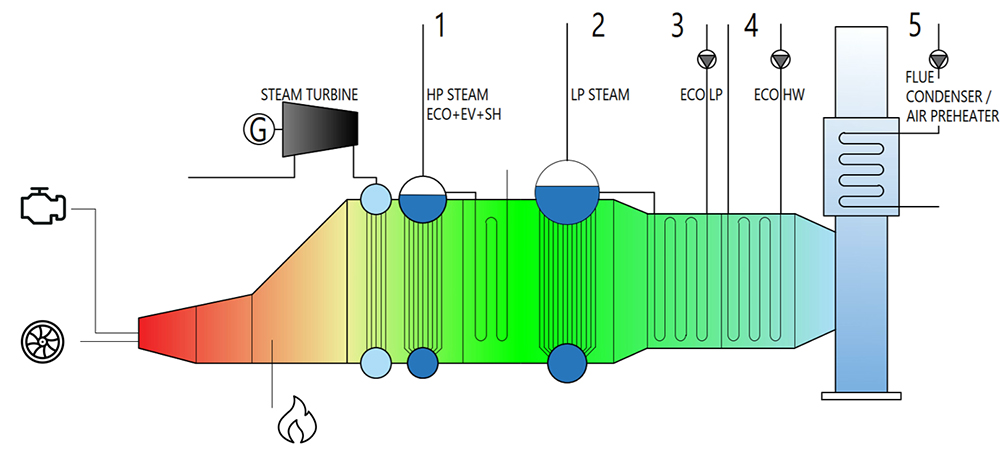
Figure 2: The components of the WT-CB combined water-tube boiler
1 High-pressure steam generator
2 Low-pressure steam generator
3 Economiser
4 Hot water recovery
5 Flue gas condenser / air preheater
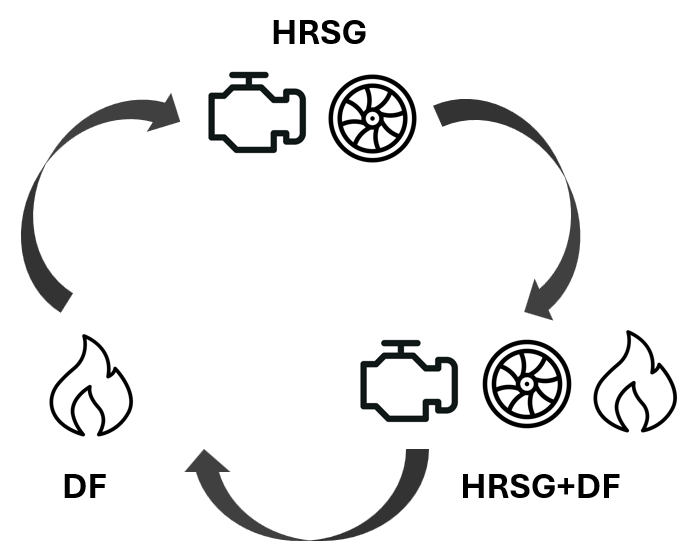
Figure 3: The three operating modes of the WT-CB boiler
HRSG (heat recovery steam generator): flue gas recovery from gas turbines
HRSG + DF (direct flame): flue gas recovery + active burner
DF: burner-only operation
How it works
The technologies used in the WT-CB boiler are well-established and widely recognised. The real added value, as Baroni points out, ‘lies not in any single component, but in the integration of all these modules into a single system’. This modularity allows the paper mill to initially install a basic configuration and subsequently add new modules as its production and energy requirements evolve. In this sense, the boiler becomes a system that evolves alongside the plant. From an operational perspective, the WT-CB can operate in three modes (Figure 3). In recovery mode (HRSG – heat recovery steam generator), steam is produced exclusively by utilising the energy recovered from the hot flue gases from upstream plants, for example from a gas turbine. In combined mode, flue gas recovery is supplemented by the DF (direct flame) combustion section, enabling an effective response to peaks in steam demand. Finally, in combustion-only mode, the boiler operates as a traditional steam generator via direct combustion, ensuring the continuity of the production process even in the event of a shutdown of the recovery systems.
Apply the different configurations
To illustrate the practical benefits of this solution, Baroni presents an example of its application. Taking as a reference a WT-CB 10000 boiler with a steam output of 10 t/h at a pressure of 18 bar, comprising an HRSG recovery section up to 5 t/h and a direct-fired (DF) section of 5–10 t/h capable of covering the entire demand, significant data emerges. In the basic configuration, assuming operation for 7,800 hours per year, efficiency stands at around 89%, with an annual consumption of over 6 million Nm³ of natural gas and more than 12,000 tonnes of CO₂ emitted into the atmosphere. The addition of the economiser module alone allows efficiency to be increased to 90%, with a reduction in gas consumption of approximately 6.3% and a decrease in emissions of around 760 tonnes of CO2 per year. By also integrating the second economiser, efficiency reaches 98%, with gas savings of nearly 9% and over 1,000 tonnes of CO2 avoided each year. In the full configuration, including the flue condenser, efficiency can exceed 102% thanks to the recovery of condensation heat, with gas savings of over 11% and a reduction in emissions exceeding 1,300 tonnes of CO2 per year. From this perspective, ‘each additional module is no longer merely a technical option, but a genuine investment,
capable of generating economic and environmental value over time’.
The benefits for the paper industry
The adoption of a combined water-tube boiler offers several advantages to the paper industry (Figure 4).
The first, explains the director, relates to efficiency and cost savings, achieved through reduced fuel consumption and the integration of different heat sources.
The flexibility in heat recovery allows the plant to utilise multiple energy streams simultaneously, whilst its compact dimensions facilitate installation even in existing boiler houses, minimising the need for major structural alterations.
The modular design allows the plant to be adapted over time, keeping pace with the growth and evolution of the paper mill.
Operational flexibility, guaranteed by the various operating modes, ensures production continuity and reliability.
Finally, the focus on environmental sustainability, thanks to the use of low-emission burners and energy recovery, enables a significant reduction in atmospheric emissions.
“The combined water-tube boiler therefore represents a practical solution for those paper mills that wish to reduce costs and embark on a path towards decarbonisation, without compromising on maximum operational flexibility,” concludes Baroni. A technical solution, therefore, that meets the current needs of the paper industry and, above all, looks to its future.
Figure 4: Results of the case study
| 1 | EFFICIENCY AND SAVINGS | Lower fuel consumption |
| 2 | FLEXIBILITY IN HEAT RECOVERY | Option to integrate different heat sources |
| 3 | COMPACT SIZE | Can be integrated into existing heating systems |
| 4 | MODULAR DESIGN | Option to expand the system at a later date |
| 5 | OPERATIONAL FLEXIBILITY | Three operating modes |
| 6 | ENVIRONMENTAL SUSTAINABILITY | Low-NOx burner with emission reduction |
Interested in a professional system?
Our experts are here to help!


